
| Our Publications | ||
| Books by Title | ||
| Books by Author | ||
| Books by Country | ||
| E-books | ||
| About | ||
| Orchid Press E-books | ||
| Distributed E-books | ||
| Our Bookshop | ||
| About Us | ||
| Browse Shop | ||
| How to Buy | ||
| Contact Us | ||
| WE BUY BOOKS AND LIBRARIES | ||
|
||
Profiles
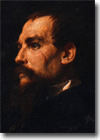
Richard Burton
Linguist, Explorer and Diplomat
From Pilpay’s Fables
(Orchid Press 2003)
Born in Hertfordshire, England in 1821, Richard Francis Burton, the son of an army colonel, developed an early reputation for both rebellion and precocity. Expelled from Oxford University, Burton joined the army of the East India Company at 21, and was posted to Sindh as an intelligence officer, where he rapidly mastered some of the most difficult languages of the region. His linguistic accomplishments remain legendary—if distinct dialects are counted, Burton eventually became proficient in some 40 languages, all told.
Burton returned to France in at the age of 29, where he wrote four books on India, and developed a scheme to penetrate the city of Mecca, entry to which was forbidden under penalty of death for non-Muslims. Completing the expedition, Burton then wrote one of his most acclaimed anthropological works, Pilgrimage to El Medinah and Mecca, 1855-56, in which he expounded not only on the city he had entered but also on the customs and lives of those he had observed.
Equally daring trips were undertaken into Africa, during which Burton discovered Lake Tanganyika and entered a second forbidden Muslim city, Harar in Somalia, becoming the first non-Muslim to have done so and to have returned alive. In 1860, he travelled to Utah, USA, to visit the Mormons and their leader, Brigham Young, subsequently writing in detail on that order, and their custom of polygamy.
Following his unlikely marriage to Isabel, a strict upper class Roman Catholic, he entered the British Foreign Office, assuming consular assignments in Fernando Po, off the coast of West Africa, as well as Brazil, Syria and Italy. In this last diplomatic post, Burton wrote extensively, producing some of his greatest and—to his Victorian readership—his most controversial books, including his famed translations of The Perfumed Garden, The Ananga Ranga, and The Kama Sutra of Vatsayana. Burton died in Trieste in 1890. Immediately following his death, many of his remaining manuscripts and diaries were burned by Isabel, in an attempt to rewrite her husband’s life within a veneer of Victorian propriety.
Burton returned to France in at the age of 29, where he wrote four books on India, and developed a scheme to penetrate the city of Mecca, entry to which was forbidden under penalty of death for non-Muslims. Completing the expedition, Burton then wrote one of his most acclaimed anthropological works, Pilgrimage to El Medinah and Mecca, 1855-56, in which he expounded not only on the city he had entered but also on the customs and lives of those he had observed.
Equally daring trips were undertaken into Africa, during which Burton discovered Lake Tanganyika and entered a second forbidden Muslim city, Harar in Somalia, becoming the first non-Muslim to have done so and to have returned alive. In 1860, he travelled to Utah, USA, to visit the Mormons and their leader, Brigham Young, subsequently writing in detail on that order, and their custom of polygamy.
Following his unlikely marriage to Isabel, a strict upper class Roman Catholic, he entered the British Foreign Office, assuming consular assignments in Fernando Po, off the coast of West Africa, as well as Brazil, Syria and Italy. In this last diplomatic post, Burton wrote extensively, producing some of his greatest and—to his Victorian readership—his most controversial books, including his famed translations of The Perfumed Garden, The Ananga Ranga, and The Kama Sutra of Vatsayana. Burton died in Trieste in 1890. Immediately following his death, many of his remaining manuscripts and diaries were burned by Isabel, in an attempt to rewrite her husband’s life within a veneer of Victorian propriety.
PO Box 70, Trinity TB, NL, A0C 2S0, Canada
Telephone: +1 709-330-4703