
| Our Publications | ||
| Books by Title | ||
| Books by Author | ||
| Books by Country | ||
| E-books | ||
| About | ||
| Orchid Press E-books | ||
| Distributed E-books | ||
| Our Bookshop | ||
| About Us | ||
| Browse Shop | ||
| How to Buy | ||
| Contact Us | ||
| WE BUY BOOKS AND LIBRARIES | ||
|
||
Book Reviews
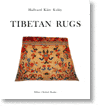
Tibetan Rugs
by Hallvard Kåre Kuløy
1982, reprinted 1983, 1986, 1989, 1995. x, 236 pp., 265 colour and 6 b & w plates, 117 b & w ill., 1 map. 21 x 19 cm., hardbound with silk binding.ISBN-10: 974-8299-94-5
ISBN-13: 978-974-8299-94-5
Tibetan Rugs
Book review by Valrae Reynolds (Orientations magazine, April 1983)
Hallvard Kuløy has produced a handsome and useful handbook, on a rather new field of collecting: Tibetan rugs. While residing in various Asian locales in his capacity as a diplomat, Kuloy has put his considerable energy into examining rugs and collecting photographs of them. The resulting handbook includes two hundred and fifty-eight examples of rugs, all illustrated in full colour, organised into sensible categories relating to usage and design. The published examples reflect the current status of Tibetan rug collecting: all but four are owned by private collectors or dealers in Europe, India, Nepal and the United States. Tibetan rug buyers are still a comparatively young group with modest means, attracted to this field by its newness, by the vitality of the subject and by the relatively low prices. Traditional nineteenth- and early twentieth-century rug collectors, most of whose holdings are now in public institutions in Europe and America, were steeped in the complex designs, subtle colours and extraordinary workmanship of Persian and Turkish carpets. To the extent that the ‘folk’ rugs of Asia, with their bold designs, bright (even garish) colours and comparatively coarse knotting, were available before the middle of this century, they were disdained by such traditional collectors. This situation will certainly change as more buyers and scholars proclaim their enthusiasm for the rich inheritance of rug-making cultures such as Tibet.
Availability has also been a major factor in this late developing field of collecting. Very little material of any sort left Tibet for America or Europe in the nineteenth and first half of the twentieth century. In the few early collections, rugs played a minor role if they appeared at all. Rugs in Tibet were practical, everyday objects, woven locally for use in homes and monasteries where they would, over time, wear out and be discarded. There were no means such as royal collections or elaborate burial customs by which the rugs would be preserved over a long period. Furthermore, there was no tradition for exporting the rugs to the outside world.
The early history of the Tibetan collection of The Newark Museum, the one institution represented in Kuløy’s handbook, is a relevant example. Begun in 1911, The Newark Museum collection was formed by American Christian missionaries working in the Sino- Tibetan border areas, the only parts of Tibet accessible to Westerners outside the strictly limited posts in southern Tibet open to British trade. Because of frequent wars and the changing social and racial status of the Sino- Tibetan areas in the years from c. 1900 to 1940, material goods were available to outsiders which would under stable conditions never have been offered for sale.
Under these circumstances, missionaries acquired and eventually sold or gave to The Newark Museum paintings, sculptures, ritual objects, garments and all manner of ethnographic paraphernalia. Not a single Tibetan rug, however, was acquired. (In Tibetan Rugs the caption to no. 44, a floral carpet in The Newark Museum collection, should read: ‘Acquired in 1978 from a Nepalese collection’, not ‘in Eastern Tibet in 1912’.) The rugs in the Museum’s collection from these early sources are all Chinese rugs which seem to have been the prevalent type in eastern and north-western Tibet. As Kuløy explains, there was little local rug production in these areas and Chinese rugs with their own distinctive colour schemes and knotting system were used. Many of these Chinese rugs were obviously made specifically for the Tibetan market as they have Tibetan inscriptions or portraits and had specialised Tibetan uses, for instance as pillar rugs or chanting mats.
The first substantial appearance outside Tibet’s borders of rugs made locally occurred in the great exodus in 1959 when thousands of peasants, monks and nobles followed the 14th Dalai Lama into India after violent fighting had erupted between Tibetans and Chinese. Those fleeing central and southern Tibet, where the main rug- weaving centres had been, carried domestic and monastic carpets as well as other portable possessions which they then sold in the Nepalese and northern Indian refugee centres. Kuløy, residing in Nepal and India, was in contact with these refugees and became interested in the quantity of Tibetan rugs available to the outside world for the first time.
In addition to presenting the pertinent characteristics of these rugs, the handbook addresses several problems which remain unsolved in documenting them: the age of the rug-making technology in Tibet and the external influences on technology and designs. Almost all extant Tibetan rugs date from c. 1880-1959 (disregarding new rugs made either by refugees outside Tibet or by Chinese-run carpet factories in Tibet after 1959), and few early references can be gleaned from historical sources. Yet Kuloy presents a well reasoned argument for a long tradition of rug production in Tibet which takes into account the nomadic heritage linked to Central Asia and the pervasive Tibetan use of portable fur, hide and wool objects. Kuloy furthermore outlines the unique properties of Tibetan rug design, reinforcing the concept of an old indigenous technology and an innovative, rather than imitative, craft tradition:
1. The knot used in Tibetan rugs is unique in modern Asia (that is, distinct technically from the knots of Persian, Turkish and Chinese rugs).
2. The bold use of colour with emphasis on a brilliant orange-red juxtaposed with deep blue, yellow, green, pink, orange and brown, is distinctive.
3. Although extant rugs show design elements familiar from Chinese rugs (dragons, phoenixes, auspicious flowers and symbols), these are combined in uniquely Tibetan ways.
4. Rugs have a wide range of uses in Tibetan society indicating their pervasive role in everyday life: khaden for sitting and sleeping (in tents, farmhouses, city apartments, government offices and monasteries), runners and back cushions for temple aisles (seating for monks during services), saddle rugs (for both top and bottom of saddle) and horse trappings, area rugs and special throne rugs for monastic use.
Tibetan Rugs will certainly be used as the standard handbook in the field for some time. The convenient size and weight of the book, the use of full colour and the sensible layout enhance its practicality. Until new documentation is forthcoming to clarify the questions of dating and stylistic development in Tibetan rugs, Kuløy’s book will be an indispensible tool for scholars and collectors.
[More Orchid Press Reviews]
PO Box 70, Trinity TB, NL, A0C 2S0, Canada
Telephone: +1 709-330-4703