
| Our Publications | ||
| Books by Title | ||
| Books by Author | ||
| Books by Country | ||
| E-books | ||
| About | ||
| Orchid Press E-books | ||
| Distributed E-books | ||
| Our Bookshop | ||
| About Us | ||
| Browse Shop | ||
| How to Buy | ||
| Contact Us | ||
| WE BUY BOOKS AND LIBRARIES | ||
|
||
Book Reviews
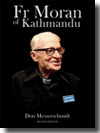
Moran of Kathmandu
Pioneer Priest, Educator and Ham Radio Voice of the Himalaya.
byDonald A. Messerschmidt
2nd ed., 2012, 388 pp., 15 b & w illustrations, index, 23 X 15 cm., softbound.
ISBN-13: 978-974-524-140-4
Moran of Kathmandu
Book review by Steve Telenius-Lowe, G4JVG RadCom
(Radio Society of Great Britain, January 1998)
I had the pleasure of meeting Marshall Moran briefly in 1985. Known throughout the amateur radio world as “Father Moran”, 9NIMM, he was on one of his occasional whirlwind world tours—in the UK whilst en route to the USA from his home in the Himalayas. In his 80th year, Father Moran had the energy of a man half his age and a mind as sharp as a razor, with an unending stream of anecdotes about life in Nepal.
Many of those anecdotes—and a lot more beside—can be found in Moran of Kathmandu. It is not an amateur radio book; it is a book about a radio amateur, and a very remarkable one at that. It starts with Marshall’s childhood in Chicago, recounts his calling to join the Jesuits (Society of Jesus), his lengthy seminary studies, and his eventual qualification as a priest. Marshall felt called to work in India, and set out 1929 to establish a mission school in Patna.
He came to know Mahatma Gandhi well, and drove Gandhi around in his jeep in an attempt to restore peace during Hindu-Muslim riots. But from the moment he first saw the Himalayas, they—and in particular the mysterious kingdom of Nepal—attracted Marshall. Twenty years after arriving in India and with the school now running succesfully, he asked to be transferred to Nepal.
In the early 1950s Nepal was a closed society in an almost impossibly remote mountain kingdom. There were no flights into the country, and Marshall’s journey across treacherous mountain passes took several days by rail, bus and even horse-drawn carriage.
Marshall Moran established St. Xavier’s school and remained a resident in Nepal for the rest of his life. He became a close acquaintance and confident of the Nepalese kings, and friendly with John (later Lord) Hunt and Edmund Hillary, the first to climb Everest.
Amateur radio played a big part in Marshall Moran’s life. He “discovered” amateur radio at a young age whilst still in the USA, but never took out a licence. Then missionary work in India and Nepal meant that, whilst amateur radio remained a latent interest, he was unable to pursue the hobby (although he was a daily listener to the BBC World Service shortwave news broadcasts). It was only in 1960, at the age of 54, that he felt able to devote some time to amateur radio. He was one of a group of three individuals who obtained the first-ever amateur radio licence issued in Nepal.
So 9NIMM was born and went on to become one of the most famous amateur radio callsigns in the World.
Amateur radio figures large in the last five chapters of Moran of Kathmandu, and gets an extremely good press. There are several examples of amateur radio being used for humanitarian purposes and one occasion where a Nepal boy’s life was saved thanks to 9NIMM. The author, whilst presumably not a radio amateur (no callsign is given), has taken the trouble to do his homework most thoroughly. The book may be of limited interest to most radio amateurs, but for those who enjoy biographies it certainly is a good read. It is well written, and for the mainstream reader of biographies it gives an extremely favourable opinion of amateur radio to those who may never even have heard of it.
[Read a review of the first edition from The Kathmandu Post] [Read a review of the first edition from The Journal of Contemporary Asia] [More Orchid Press Reviews]
PO Box 70, Trinity TB, NL, A0C 2S0, Canada
Telephone: +1 709-330-4703