
| Our Publications | ||
| Books by Title | ||
| Books by Author | ||
| Books by Country | ||
| E-books | ||
| About | ||
| Orchid Press E-books | ||
| Distributed E-books | ||
| Our Bookshop | ||
| About Us | ||
| Browse Shop | ||
| How to Buy | ||
| Contact Us | ||
| WE BUY BOOKS AND LIBRARIES | ||
|
||
Book Reviews
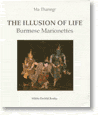
The Illusion of Life
Burmese Marionettes
by Ma Thanegi
1995. viii, 108 pp., 101 colour plates, 17 b & w drawings. 22 x 19 cm.
ISBN-10: 974-8304-03-5 Softbound $23.00
ISBN-13: 978-974-8304-03-8
ISBN-10: 974-8299-61-9 Hardbound $29.00
ISBN-13: 978-974-8299-61-7
The Illusion of Life: Burmese Marionettes
Book review, by Miriam Kapp
(Crossroads: An Interdisciplinary Journal of Southeast Asian Studies, Volume 13, Number 1)
In this work, Ma Thanegi sets out to give the reader a glimpse of the “wit, spirit and style” (p.vi) of the Burmese people, as the marionette theater itself has done in the past. In the introduction and the first four chapters the author provides an historical overview. She details the rules and conventions governing performers and performances, including those intended to guarantee the good disposition of the spirits, and she describes the way of life of the performers as well.
Ma Thanegi, among others, makes the interesting point that the marionette theater is thought to have flourished in part because it was not bound by many of the conventions that had to be respected by live actors (p. 4). In some instances, this resulted in more realism in the puppets’ behavior, but in others it resulted in less. For example, in romantic scenes live actors were never allowed to touch one another, but the dolls could be demonstratively affectionate. Less realistically, however, puppets representing people of a lower status could be larger than their superiors and thus above them, or puppets might be dressed in the complete regalia of the king, or in the robes of a monk. It would have been interesting if the author had followed this line of inquiry in order to ascertain whether these freedoms were used to comment on political situations.
In spite of lavish costumes and exquisitely-made puppets capable of precise movements, the most important aspect of the marionette theater was not the visual but the acoustic. The division of labor among the puppeteers provided for musicians, handlers and vocal artists, but it was the singer with his rhetorical skill who created the illusion of life. The singer was also accorded more freedom than would have been possible in real life, and in fact, is often said to have been a spokesman for the king or for his subjects, transporting subtle messages in songs and dialogues (pp. 8-11). Indeed, the relationship of both the marionette and the live theater with the authorities and with oppositional groups is a theme in itself. As Ma Thanegi points out, the puppeteers spread patriotic songs throughout the country before the turn of the century. Chapter 5 treats the instruments, the orchestra, and briefly, the music. Chapter 6 covers the set of individual marionettes most commonly used. It is worth noting that neither today’s omnipresent soldier, nor representatives of ethnic minorities (which together are estimated to make up one third of the population) are in this set. In chapter Seven, the construction of the marionettes and some of the ancillary handicrafts are described. At this point, a chapter on the stage, backdrops, and requisites would have been a nice addition. Chapter 8 is devoted to puppeteers and singers, past and present, and chapter 9 provides a vivid picture of the surroundings within which a puppet performance takes place. The book closes with a Cultural Vocabulary section offering generous explanations of over twenty terms, and covering various aspects of the Burmese way of life not directly related to, but worthwhile in the understanding of the larger framework within which the marionette theater exists. Excellent photographs, most of which were taken by the author, accompany and illustrate the text and provide not only close-ups of the various puppets but also rich contextual information. The text is well-organized, lively, and readable. Ma Thanegi has made good use of the Burmese language sources which are inaccessible outside of Burma and has augmented them with material from secondary sources and information drawn from field work. This is a competent presentation of the Burmese marionette theater but the reader is left wishing for more. Short translations of some of the stock texts-descriptions of the forest, the bragging daring of the “bilu” or ogre, the wailing of the princess, or even synopses of plays would have been an additional pleasure and quite in keeping with the importance of the language in the marionette theater itself. In view of the scholarly attention to the performing arts in Southeast Asia, it is to be welcomed that this introduction to the modern Burmese marionette theater has appeared for an international readership alongside Axel Bruns’ German translation of parts of U Hla Tin’s (Hla Thamein’s) work in Burmese (Birmanisches Marionettentheater, Berlin: Axel Bruns, 1990) and Noel Singer’s largely historical Burmese Puppets (Singapore: Oxford University Press, 1992).
Because the book is not aimed at an academic audience, the lack of an index and a bibliography cannot be fairly criticized. As it stands, it admirably fulfills the author’s intention and is a worthwhile contribution to the English-language literature on Burma. Those with a general interest in Burmese culture or a special interest in the performing arts, Burmese arts and crafts, or anthropology will appreciate this attractive little volume.
Miriam Kapp
Bonn, Germany
[More Orchid Press Reviews]
PO Box 70, Trinity TB, NL, A0C 2S0, Canada
Telephone: +1 709-330-4703