
| Our Publications | ||
| Books by Title | ||
| Books by Author | ||
| Books by Country | ||
| E-books | ||
| About | ||
| Orchid Press E-books | ||
| Distributed E-books | ||
| Our Bookshop | ||
| About Us | ||
| Browse Shop | ||
| How to Buy | ||
| Contact Us | ||
| WE BUY BOOKS AND LIBRARIES | ||
|
||
Book Reviews
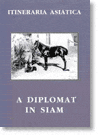
A Diplomat in Siam
byErnest Satow C.M.G.
Introduced and Edited by Nigel Brailey
2000. 208 pp., numerous b & w sketches, 2 maps, index. 19 x 13.3 cm., Softbound, hard slipcase.
ISBN-10: 974-8364-73-6
ISBN-13: 978-974-8364-73-1
The Product of a Period
Book review by Michael Smithies
(The Nation, Bangkok, November 12, 2000)
Satow is well-known for his writings on diplomacy and his stays in Meiji Japan. It is less well known that he was the British minister resident in Bangkok from 1885 to 1888.
On December 1, 1885, he started out on a tour of the north of Siam, through the then tributary, Lao states of Prae, Lampang (“Lakhon”), Lamphun, and Chiang Mai, returning to Bangkok on March 11 the following year.
This book is essentially a record of that journey, but as he says almost nothing about the official purpose of his journey (looking into the functioning of the extra-territorial courts) the title of the book is inappropriate, even if it does form a pendant to his better-known work A Diplomat in Japan, not published until 1921.
The original title he gave the written-up diary was Diary of a Journey from Bangkok to Chiengmai and Back, 1885-86 or Travels in Siam. Either would have been better than that selected here.
Using horse, elephant, pony, boat, and raft, he and his two companions went first to Phichai and Phisanuloke and explored the ruins of Sukhothai and Srisatchanalai — being among the first Westerners to do so.
They camped in the sala or even the bot of temples, “tiffined” (ie lunched) usually in style while bearers brought chairs, tables, etc.
The local dignitaries were supposed to provide guides, but more often than not did little to help the travellers. Their journey was slow, often uncomfortable, and occasionally dangerous.
But there were some civilised pleasures even so; sitting on his elephant howdah, Satow “passed by some rice fields into wood, and being absorbed in a book, did not notice what was going on…”
The group observed carefully (Satow is keen on his plants and flowering trees: the book might well be called “A Botanist’s Siam”), but his comments on the state of government in the country are less than flattering: whether Lao Chao or Siamese officials, local dignitaries oppressed the people under them, rarely paid for anything, and were ardent practitioners of nepotism.
Indeed, Satow has some very undiplomatic comments to make at what he sees, only in respect of local governance.
Perhaps with justification, he pokes fun at the meaning of Nakhon Sawan (“city of heaven”) typifying “a sort of brag that induced the early Siamese to bestow such magnificent appellations on their collections of dirty hovels”.
In Lampang he notes: “;In the matter of good manners the Laos are no better than savages” because the chief did not send a message of thanks for the admittedly “trifling present” Satow had sent him.
Nor do the Siamese come off much better in character assassination: “the Siamese are destitute of all enterprise” and their women “devoid of all physical attractions, and exceedingly masterful”.
Opinions change over time.
Satow takes several swipes at Carl Bock’s then recently-published book Temples and Elephants (1884) for its inaccuracies, but is forced to admit the Norwegian explorer was more than occasionally correct: “Mr Bock’s description of the phra-chedi or pagoda [at Lamphun] is so far accurate that there is little to be added.”
The poor Chao of Chiang Mai did not know what to make of the party; all three Englishmen were unmarried, and he was greeted by Satow’s Japanese servant dressed in his national costume, which “greatly excited his interest”.
He was quite unable to believe that (in November 1885) “the British forces had taken Mandalay, the whole story was too incredible … everyone knew it was impossible”.
The style is only occasionally what might be termed “imperialistic bombast”, as when speaking with praise of two junior official who wanted to change the ways of old Siam, Satow writes: “Chill penury had not sufficed, to depress their noble zeal for the welfare of their country, nor had the excessive qualification of avarice blunted their natural indignation which every decent man feels at the sight of unrestrained despotism.”
For the most part, the style is less laboured.
The book has been edited by Nigel Brailey, who has supplied some helpful footnotes. Occasionally one feels that less respect for the original text might have been in order.
Had Satow really checked his manuscript carefully, he would surely not have left thrice-repeated information that the ex-missionary turned businessman, Dr Cheek, spoke Lao like a native.
It is a pity that no metric conversions are provided for the antediluvian imperial measurements and temperatures employed by Satow.
There are rather more typos (some computer-induced) than one would like, and word-breaks like el-ephant are intolerable. The original sketches are reduced in size, so that sometimes they are too small to be of value; occasionally they could have benefited by being blown up larger than the originals, when showing a range of mountains, for example.
But for detailed descriptions of the old economy of logging in the north, an early visitor’s impressions of Sukhothai, and the scenery around Doi Suthep and Samoer: this book has few rivals.
Very much a product of its period, it is a good read, though one has to be on one’s guard about the stereotypes described. Generalizations are usually meaningless.
[More Orchid Press Reviews]
PO Box 70, Trinity TB, NL, A0C 2S0, Canada
Telephone: +1 709-330-4703