
| Our Publications | ||
| Books by Title | ||
| Books by Author | ||
| Books by Country | ||
| E-books | ||
| About | ||
| Orchid Press E-books | ||
| Distributed E-books | ||
| Our Bookshop | ||
| About Us | ||
| Browse Shop | ||
| How to Buy | ||
| Contact Us | ||
| WE BUY BOOKS AND LIBRARIES | ||
|
||
Book Reviews
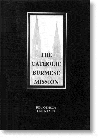
An Outline of the History of the Catholic Burmese Mission from the Year 1720 – 1857
byPaul Ambrose Bigandet
1887, 1995. vii, 152 pp. 19 x 13.3 cm., Softbound.
ISBN-10: 974-8299-75-9
ISBN-13: 978-974-8299-75-4
For the Converted
Book review by Michael Smithies (The Nation, Bangkok, date unknown)
This book is a reprint of a work first published in Rangoon in 1887, written by the then Bishop of the Southern Burma Mission to celebrate his golden jubilee, apparently as head of the mission.
In fact, the book correctly starts with the appearance of Westerners in Burma, who brought their religion with them. The first were merchants, “worthy lovers of lucre”,who came in the fiftenth century.The taking of Goa brought the Portuguese into contact with the region, and led to the appearance of adventureres like Philip de Brito, the de facto ruler of Syriam, and the delectable rogue Mondes Pinto.
The Milanese Barnabite fathers arrived in Burma in 1721; their elected bishop with the title of Maxula was consecrated in 1768 by Mgr Brigot, the Apostolic Vicar of Siam, on his way to Pondicherry, who had been taken after the fall of Ayutthaya along with Siamese captives to Burma. The Barnabites were soon in conflict with the Portuguese Catholics, whose bishop at São Tome de Meliapur on the Coromandel Coast claimed jurisdiction over Burma.
The Napoleonic invasion of Italy led to the mission being taken over by the Sacred Congregation in Rome, and later by the French Foreign Missions, and a string of Italian and French priests was sent to Burma. Thereafter the book is a long succession of names of priests and their often indifferent health parishes established, sometimes closed, churches built, sometimes destroyed, until 1869, when the Burmese mission was divided, like Gaul, into three parts; after that the text is concerned principally with events in the Rangoon, Tavoy, Moulmein, and Mergui region.
The missonaries brought their Burmese and English printing presses with them, they set up schools and orphanages, they worked with the tribal groups like the Kachins, and did not apparently concern themselves with medicine. But education was not always successful: too often children were taught the art of reading and writing by a process almost similar to that used for teaching animals to play some part they are not led by their instinct to perform, a familiar enough critique of rote teaching methods in the region today.
The present volume, though, is handsomely presented and bound, and specialists will doubtless appreciate it.
[More Orchid Press Reviews]
PO Box 70, Trinity TB, NL, A0C 2S0, Canada
Telephone: +1 709-330-4703