
| Our Publications | ||
| Books by Title | ||
| Books by Author | ||
| Books by Country | ||
| E-books | ||
| About | ||
| Orchid Press E-books | ||
| Distributed E-books | ||
| Our Bookshop | ||
| About Us | ||
| Browse Shop | ||
| How to Buy | ||
| Contact Us | ||
| WE BUY BOOKS AND LIBRARIES | ||
|
||
Book Reviews
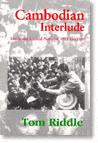
Cambodian Interlude
Inside the 1993 United Nations’ Election
byTom Riddle
1997, 2000, 210 pp., 20 b & w plates. 21.5 x 15.2 cm., Softbound.
ISBN-10: 974-8299-36-8 $20.00
ISBN-13: 978-974-8299-36-5
Cambodian Interlude
Inside the United Nations’ 1993 Election
Book review by John Marston
(Pacific Affairs 129 Vol. 72 No.)
This book, a memoir of the U.N. presence in Cambodia in the period leading up to the 1993 elections, is written for a popular audience. On its own terms it works - the question being, what are those terms?
Riddle is an American who taught English in refugee camps in Thailand and later did graduate work in anthropology at the University of Hawaii. The book recounts, from a very personal perspective, his experiences from March 1992 to July 1993, working as a United Nations Volunteer (UNV) for the Electoral Division of the United Nations Transitional Authority in Cambodia (UNTAC). UNV’s were known within UNTAC for being motivated by idealism and for the long hours they worked at low pay. Riddle worked with computers in the UNTAC electoral headquarters. (I also worked for UNTAC, in another division, but never had contact with Riddle.)
In the ‘grand tradition’, Riddle’s relation to Cambodia is embodied in his love for a beautiful woman, a thirty-year-old Cambodian co-worker; Sovann, who had recently come from a refugee camp on the Thai border. Ultimately she rejects his proposal of marriage. Sovann, as an icon of purity, elegant and aloof, is held up in contrast to the loose morality of many UNTAC staff, and to the prostitutes of Thailand and Cambodia, whom Riddle describes in fascinated detail, but never touches.
This story unfolds against the backdrop of the UNTAC period. Simply in terms of recounting a basic narrative of that period, Riddle’s book is perhaps the most successful I have read so far. Clearly and dramatically, he retells the sequence of events and the popular moods associated with them, as they were perceived by many of us working in Phnom Penh. As he readily acknowledges, much of what he knew about what was going on in the country was gleaned at the time by reading the English-language newspapers, the Electoral Component newsletter and other reports.
Take away the love story and the second-hand historical narrative, and Riddle is mostly in a position to report on his experiences working with UNTAC computers. This is not totally without interest. There is no little irony in the idea that the U.N., at great expense, was willing and able to superimpose the theater of its high-tech election on a low-tech country. Riddle writes about his experiences with wit and narrative flair, but this in and of itself would not be enough to sustain the interest of the book.
Cambodia Interlude is a much better read than the book it most closely resembles as a popular memoir, Radio UNTAC of Cambodia, by Zhou Met (Bangkok: White Lotus Press, 1994), although Radio UNTAC probably provides more information that would be useful to future historians. (Neither of these books represents the ambition, in terms of political and social analysis, of a book like Propaganda, Politics, and Violence in Cambodia, Steve Heder and Judy Ledgerwood, editors [Armonk, N.Y.: M. E. Sharpe, 1996]—a collection of articles by people who had worked in the: UNTAC Information/Education Division —in effect a totally different genre.) Cambodia Interlude is rather an efficient summary of the kinds of things that journalists were writing and people in Phnom Penh were talking about at the time, but is not a source of much new information or a new synthesis of the old.
Much of the effect of the book depends on its tone of hip irony. This, with its frankness and humor, is both its strength and its weakness, in that it ultimately serves to keep the country and the events happening in it at arms’ length.
I found myself liking the persona of the author and cannot judge too harshly a book that successfully evoked my own memories of UNTAC. Nevertheless, I cannot help wishing that Riddle or his editors had pushed a little harder to move beyond the limits of the genres of travel writing and popular fiction within which the book is framed. Would I assign this book for a class on Cambodia? Probably not. I would recommend it for reading on the plane or between swims on a beach in Southeast Asia somewhere other than Cambodia.
John Marston, Colegio de Mexico, Mexico City, Mexico
[Read a review from Farang Untamed Travel] [More Orchid Press Reviews]
PO Box 70, Trinity TB, NL, A0C 2S0, Canada
Telephone: +1 709-330-4703