
| Our Publications | ||
| Books by Title | ||
| Books by Author | ||
| Books by Country | ||
| E-books | ||
| About | ||
| Orchid Press E-books | ||
| Distributed E-books | ||
| Our Bookshop | ||
| About Us | ||
| Browse Shop | ||
| How to Buy | ||
| Contact Us | ||
| WE BUY BOOKS AND LIBRARIES | ||
|
||
Book Reviews
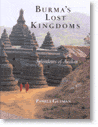
Burma’s Lost Kingdoms:
Splendours of Arakan
byPamela Gutman
, photography byZaw Min Yu
2001. 188 pp., 180 colour and b/w photos, 5 maps, chronology, bibliography, glossary, index. 28.5 x 22 cm. Hardbound.
ISBN-10: 974-8304-98-1 $45.00
ISBN-13: 978-974-8304-98-4
Burma’s Lost Kingdoms
Splendours of Arakan
Book review by Tilman Frasch
(International Quarterly for Asian Studies, May 2003, Arnold Bergstraesser Institute)
By and large, Arakan has been a white spot on the scholarly world map, until in recent years scholars in France, the USA and the Netherlands wrote dissertations on various periods and aspects of the history of this coastal area. Responding to their research, the Dutch Academy of Sciences sponsored a conference on coastal Burma—in fact mainly dedicated to Arakan—the proceedings of which have just been published in book form. In this newly investigated field, the Australian art historian Pamela Gutman can be regarded as a kind of dinosaur: Her thesis on “Ancient Arakan with special reference to its cultural history between the 5th and the 11th centuries” was submitted to ANU as early as 1976, though it was unfortunately never published.
Therefore, it is to be welcomed that she has used her acquaintance with the Arakanese photographer Zaw Min Yu to produce a splendid volume on the lost kingdoms of Arakan. As the title suggests, the book focusses on the Mrauk-U (or Mrohaung) period when Arakan was an independent kingdom, roughly from the 14th to the 17th century. Most of the monuments at Mrauk-U were built in the course of these (roughly three) centuries. Now declared a national heritage site, the monuments are undergoing a ‘renovation’ programme comparable to the one started at Pagan, and it is to be expected that some of the pictures shown in the book record a state of preservation that future visitors will no longer be able to see.
As indicated above, Gutman’s field of expertise is the early history of Arakan, and therefore artefacts from the centuries preceeding Mrauk-U are also documented. Those interested in epigraphy will especially welcome the picture with the rock inscription by King Kawlia from the year 1123 C.E., one of the two Burmo-Arakanese inscriptions known so far (p. 14). Unfortunately, the picture is too poor to allow reading, though judged by the script it appears to be younger than the 12th century when it was supposedly written. Besides Mrauk-U, earlier phases of Arakanese history are taken into regard, too.
Gutman had access to several private collections which consist mostly of bronze (and to a lesser degree, stone) images of Buddhas and Buddhist deities. Arakan had always been a frontier zone between Theravada-dominated Burma and Bengal where other, sometimes syncretist religions flourished. It is therefore not surprising that a considerable number of images found in Arakan were dedicated to Mahayanist and Hindu deities.
It is an enjoyable publication, since it has the qualities of a coffee-table book without ever hiding its scholarly perfections. The only part where the latter are missing is in the introduction which seems to have been produced in a hurry, as it contains a number of mistakes. Thus, Fra Mannque, the Portuguese monk who visited Arakan in the early 17th century belonged to the order of the Augus-tines (and not Jesuits, p. 20), and it was during the reign of king Sirisudhammaraja (and not Sandasudhammaraja). Another source of mistakes are the references to the illustrations in the text, where on and off the numbers of pages and plates are mixed. These are, however, minor errors and can hardly detract from the overall positive impression.
[Read a review from Antiquity magazine] [Read a review from Tai Culture magazine] [Read a review from Asian Perspectives] [More Orchid Press Reviews]
PO Box 70, Trinity TB, NL, A0C 2S0, Canada
Telephone: +1 709-330-4703