
| Our Publications | ||
| Books by Title | ||
| Books by Author | ||
| Books by Country | ||
| E-books | ||
| About | ||
| Orchid Press E-books | ||
| Distributed E-books | ||
| Our Bookshop | ||
| About Us | ||
| Browse Shop | ||
| How to Buy | ||
| Contact Us | ||
| WE BUY BOOKS AND LIBRARIES | ||
|
||
Book Reviews
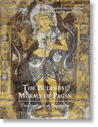
The Buddhist Murals of Pagan
Timeless Vistas of the Cosmos
byClaudine Bautze-Picron
with photography byJoachim Karl Bautze
2003. 280 pp., 253 colour plates. 28 x 22 cm., hardbound.
ISBN-10: 974-524-025-7 $60.00
ISBN-13: 978-974-524-025-4
Book review by Tilman Frasch
(Asia Research Instutute, Singapore)
(Artibus Asiae - Published by Museum Rietberg, Zurich)
Anyone who has been inside one of the temples of Pagan will certainly remember how little there was to be seen. The vaults are high, the passages narrow, and the temples (at least the early ones) so poorly lit that even with the help of a searchlight the majority of their wall paintings remain invisible to the beholder. A further problem is the sometimes poor state of preservation, with parts of the plaster having fallen off and colors fading. Even if the paintings could be seen, it would not always be easy to identify what they depict for one has to be familiar with a broad range of Buddhist scriptures in order to recognize the contents of the paintings. An attempt to display and annotate these paintings is therefore an adventurous task, all the more so when one seeks not simply to portray a few easily accessible temples, but to conduct a broad and comprehensive survey comprising temples as far away as Sale, one of the satellite cities of Pagan some 30 miles to the south. Yet in a fascinating and truly convincing manner, Claudine Bautze-Picron, an art historian working with the French CNRS, has succeeded in throwing the temple doors of Pagan wide open to unfold their interiors in spectacular photographs contributed by her husband, Joachim Bautze.
The material is presented in seven chapters. The first chapter introduces the temples of Pagan included in the survey and the various ways in which their walls have been decorated. The second deals with the representations of the life of the Buddha, consisting of the eight great scenes usually centered on the main image of the temple. The stories of the former lives of the Buddha, the jatakas, are the subject of chapter 3, which is followed by a study of the Buddhas of the past. The next two chapters concentrate on the secondary figures (monks, worshippers, kinnaris, etc.) in the paintings and the general ornamental decoration. The final chapter, humbly called “Pagan Murals - A Guide,” examines the individual works, thus far analyzed separately, within their temple context and suggests dates for the buildings on the basis of the art historical evidence. The book concludes with a chronology of the murals of Pagan.
The book neither attempts to present a new theory of Pagan art nor does it boast of spectacular discoveries. Rather it concentrates on a full and clear documentation of the evidence, especially through the more than 250 color pictures. The book thus provides a solid basis for further explorations into the fields of Burmese and Buddhist art. In fact, many questions emerge from it. Why, for instance, are the footprints of the Buddha generally located on the ceiling of the porch or in the passage to the sanctum? Why is the Buddha on plate 40 (p. 44) protected by the Naga king Muchalinda, an episode from the sixth week after his enlightenment, while at the same time holding a bowl in his hands-which usually indicates his first meal, presented by Tapussa and Bhallika, in the seventh week? And on the opposite page (pi. 41, p. 45), the Buddha is seen together with deer, wheel, and attending monks, all of whom belong to the scene of the first preaching in the deer park at Sarnath, but instead of raising his hands in the gesture of exposition, Buddha is touching the earth. Are such unusual compositions mistakes by the painters, or do they possess a deeper meaning?
Another question is raised at the beginning of the book: “Treasures hide in the temples of Pagan-treasures in part never meant to be seen.” Implicitly, this remark contributes to the ongoing debate in Asian art history whether the jatakas or other wall paintings were intentionally hidden away, as was the case in the cave temples of Ajanta or in Wat Si Chum in Sukhothai. Without ignoring the difference between these monuments and the temples at Pagan, the answer seems to be yes. But can it really be imagined that the Pagan paintings were works of merit so humble that they were not meant to be seen by anyone, in marked contrast to the magnificence of the temple itself, which was built by the same donor as a lasting symbol of both his piety and his aspiration for nibbana. Indeed, why should an artist waste time and (sometimes expensive) pigments on paintings that could as well have been drawn with charcoal?
The matter obviously must be approached in a more pragmatic manner: the artists seemingly did have enough light to produce their masterpieces, to compose, outline, and color their paintings. If today we are unable to see and understand their works, we should perhaps start thinking about the way the artists worked. Unfortunately, no one has ever tried to find out how many oil lamps or candles (donated by the hundreds, as several inscriptions from the Pagan period assert) it takes to bring enough light into a temple. (In passing, we may also note that photographers in the early-twentieth century succeeded in lighting the monuments sufficiently with mirrors to take pictures without using a flashlight). Obviously, there is much to be seen and more to be studied on the temple walls of Pagan, but with this magnificently illustrated book, we now have an indispensable research tool and source book in hand to go deeper into the world of early Burmese Buddhist art.
[Read a review from Cambridge University Press] [Read a review from The Asian Arts Society of Australia] [Read a review from The Journal of the Siam Society] [More Orchid Press Reviews]
PO Box 70, Trinity TB, NL, A0C 2S0, Canada
Telephone: +1 709-330-4703