
| Our Publications | ||
| Books by Title | ||
| Books by Author | ||
| Books by Country | ||
| E-books | ||
| About | ||
| Orchid Press E-books | ||
| Distributed E-books | ||
| Our Bookshop | ||
| About Us | ||
| Browse Shop | ||
| How to Buy | ||
| Contact Us | ||
| WE BUY BOOKS AND LIBRARIES | ||
|
||
Book Reviews
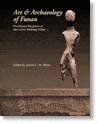
Art & Archaeology of Fu Nan
Pre-Khmer Kingdom of the Lower Mekong Valley
byJames C. M. Khoo
, editor29.0 x 21.0 cm, 174 pp., 93 colour and 2 b&w plates, 9 drawings, 6 maps, bibliography, index, hardbound
ISBN-10: 974-524-035-4 $45.00
ISBN-13: 978-974-524-035-3
The Straits Times
Review by Richard Lim Singapore, August 23rd, 2003500 Years of Glory, Then it Vanished.
Diggings by a Vietnamese team in the last 25 years have unearthed more clues to the mystery that was Fu Nan, South-east Asia’s first thriving polity. It was South-east Asia’s first thriving, cosmopolitan entrepot.
Traders from India, China, Persia and the Indonesian archipelago converged in this city, situated on the Gulf of Thailand near the mouth of the Mekong River, to buy and sell goods.
This was Oc Eo, part of a kingdom or polity which the Chinese called Fu Nan. It occupied an area that covers parts of today’s Vietnam, Cambodia and Thailand, right down to the Isthmus of Kra.
By all accounts, Fu Nan was a thriving polity, with a highly sophisticated network of canals that facilitated agriculture and the transport of people and produce.
It was a commercial hub, an arbitrage for trade between China and India, the Mediterranean polities, the Middle East and Africa.
But glorious as it was, Fu Nan lasted only 500 years, from the first century to the sixth. Then it disappeared.
Historians, archaeologists and scholars cannot say exactly how the once thriving polity declined and died. Neither are they certain who the people of Fu Nan were. To this day, much of what Fu Nan was remains a mystery.
But there is no doubt that it had played a pivotal role as the precursor and early foundation of Khmer culture.
More importantly, as archaeologist John Miksic says: “The stories of Oc Eo and Fu Nan hold the key to understanding much about the entire ancient history of Southeast Asia.”
Fu Nan was first discovered by French archaeologist Louis Malleret in 1942.
In the two years he was in the region, he discovered some 20 sites and wrote a few volumes on Oc Eo culture, based largely on ancient Chinese records. In the last 25 years, after the end of the Vietnam War, Mr Vo Si Khai and his colleagues from the Institute of Social Science in Ho Chi Minh City have devoted their energies to picking up from where Malleret had left off.
With minimal resources, they have so far identified 90 sites and excavated more than 20 of them. Unfortunately, their worthy work had largely gone unreported in the West. A dialogue of this nature with the West is important because it will generate interest in the project, and help bring in the much needed funds and more research and scholarship.
But this has now been set right by Dr James Khoo, one of Singapore’s longest-practising neurosurgeons whose other great passion is history and culture.
Yesterday, at the Asian Civilisations Museum (ACM), Minister of Trade and Industry George Yeo launched a much-needed book edited by Dr Khoo, titled Art & Archaeology of Fu Nan.
An effort that took five years, the book was a labour of love for the surgeon, 58, who was also the former chairman of the ACM. It is a recognition of the work that Mr Vo, now 65, had undertaken against many odds in the last quarter of a century.
So driven was Mr Vo in his Fu Nan project that he sold half his house to finance his diggings, as Dr Khoo relates it.
The latter had made all the necessary preparations for Mr Vo to fly out here for the book launch, but an illness had detained him back home.
In putting together the book, Dr Khoo had assembled a team of experts to write on the various aspects of Fu Nan and Oc Eo, based largely on the finds unearthed by Mr Vo and his team.
They include Dr Miksic, associate professor at the Southeast Asia Studies Department of the National University of Singapore; art historian Kwa Chong Guan; American archaeologist Miriam Stark; and Heidi Tan, curator in charge of the Southeast Asia department in the ACM.
The heart of the book is an extended essay by Mr Vo himself. It provides details of the many sites which he has excavated, and an authoritative look at the history of Fu Nan and the Oc Eo culture.
Dr Khoo contributed an essay on the religious sculptures which have been dug up in recent years in the various sites spread over the Mekong Delta. These folk sculptures, mainly of the Indian deity Vishnu, have individual faces, as with China’s terracotta warriors, and they are often depicted smiling.
“They were likely to be common household deities, and the smiling faces indicate a people who were likely to have been prosperous and happy,” says Dr Khoo.
Lovely pictures of these sculptures and other cultural and religious artefacts make the book a visual treat, on top of it being a valuable document of history.
For Dr Khoo, the book was a bringing together of East and West.
He says: “It was a collaborative effort between Asean and Western scholars.
“I hope it will be the catalyst for more such collaborations and research and scholarship work on South-east Asian history.”
Art & Archaeology of Fu Nan is available at bookshops at (Singapore Dollars) $80. Seventeen per cent of the royalties will go towards a research fund set up under the auspices of the Southeast Asian Ceramic Society.
[Read a review from The Journal of the Siam Society] [More Orchid Press Reviews]
PO Box 70, Trinity TB, NL, A0C 2S0, Canada
Telephone: +1 709-330-4703