
| Our Publications | ||
| Books by Title | ||
| Books by Author | ||
| Books by Country | ||
| E-books | ||
| About | ||
| Orchid Press E-books | ||
| Distributed E-books | ||
| Our Bookshop | ||
| About Us | ||
| Browse Shop | ||
| How to Buy | ||
| Contact Us | ||
| WE BUY BOOKS AND LIBRARIES | ||
|
||
Book Reviews
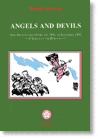
Angels and Devils
Thai Politics from February 1991 to September 1992 a Struggle for Democracy?
byDavid Murray
. With an introduction byWithaya Sucharithanarugse.
1996, 2000, xxvii, 314 pp., 15 figs., 50 b & w pl., 59 cartoons. 21.5 x 15.2 cm., Softbound.
ISBN-10: 974-8299-33-3
ISBN-13: 978-974-8299-33-4
Angels and Devils
Book review by Andrew Brown
(Pacific Affairs, date unknown)
This volume should appeal to anyone interested in acquiring a detailed empirical record of a significant period in Thailand’s recent political history. Based largely on information published in Thailand’s English language dailies (The Nation and Bangkok Post), supplemented by sources drawn from other journalistic writings (eg., Far Eastern Economic Review), Murray offers an insightful account of the period beginning with the military overthrow of the Chartichai government in February 1991 through to the election of the Chuan administration in September 1992. In nine chapters Murray takes the reader on a detailed tour of events and introduces us to the main personalities, institutions and issues which dominated national political debate during this crucial nineteen-month period. Although the author states that the book “is not intended to be an academic treatise” (p. xxiii), a concluding chapter places the events surveyed in the context of wider theoretical debates over the relationship between economic development and democratic transitions.
Murray is at his best piecing together and describing the ebb and flow of political struggle. His analysis of the rise of the military’s National Peace Keeping Council and the reasons for their opposition to the Chartichai government; the overview of the activities and policies implemented by the Anand Panyarachun administration; the discussion of vote-buying and electoral corruption; the account of the formation of the Suchinda government; his discussion of the rising tide of opposition to Suchinda which culminated in the bloody events of May 1992; the return of Anand; the reformation of political parties and the electioneering leading up to the September 1992 polls are all competently handled with an astute eye for detail. The narrative is enhanced by the inclusion of various tables, timelines, photographs and some clever political cartoons which capture splendidly some of the key issues and debates of the times.
Though presented as a straightforward empirical study, Murray’s selection and interpretation of the data is, of course, shaped by an implicit theoretical framework. Basically, Murray aligns himself with dominant pluralist approaches which interpret the events of 1991 and 1992 in terms of the extent to which they can be seen to have contributed to the demise of the “bureaucratic polity” and the establishment of political structures and processes characteristic of liberal-democratic regimes. But is the erection of this kind of regime the most likely for Thailand? Murray is uncertain. Perhaps an answer to the question requires a detailed inspection of just how the term “democracy” is understood within contemporary Thai society. As Murray notes, in the street rallies of late 1991 and 1992 there were numerous calls for democracy “but what that actually meant was ill defined” (p.262). The analysis might thus have been improved by a closer investigation of the competing understandings of the meaning of “democracy.” For the bourgeoisie, does “democracy.” mean a system that allows for a greater input into processes of economic policy formation while at the same time retaining some hierarchical and nonparticipative structures consistent with “traditional” Thai culture? For the burgeoning industrial working class, a new social force which doesn’t attract much attention in Murray’s analysis, is “democracy” equated to being granted a greater voice in the formal political sphere or does it also extend to include wider notions of participation in the control and allocation of economic resources? And how do the middle classes understand the term? A more nuanced teasing out of the competing views on “democracy” would have offered a deeper insight into the events of 1991 and 1992 and what they mean for the future shape of politics in Thailand.
[More Orchid Press Reviews]
PO Box 70, Trinity TB, NL, A0C 2S0, Canada
Telephone: +1 709-330-4703