
| Our Publications | ||
| Books by Title | ||
| Books by Author | ||
| Books by Country | ||
| E-books | ||
| About | ||
| Orchid Press E-books | ||
| Distributed E-books | ||
| Our Bookshop | ||
| About Us | ||
| Browse Shop | ||
| How to Buy | ||
| Contact Us | ||
| WE BUY BOOKS AND LIBRARIES | ||
|
||
Book Reviews
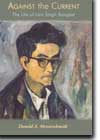
Against the Current:
The Life of Lain Singh Bangdel
byDonald A. Messerschmidt
withDina Bangdel
1st edition 2004. 232 pp., 12 b & w and 10 colour plates 24.5 x 17.5 cm., hardcover
ISBN-10: 974-524-052-4
ISBN-13: 978-974-524-052-0
Against the Current
Book review by Rajeev Goyal (Peace Corps Worldwide, date unknown)If you have not yet read Against the Current by Don Messerschmidt, you are missing out.
Messerschmidt, who has lived on and off in Nepal for the last 45 years, has written a powerful and important book about an extraordinary artist, Lain Singh Bangdel. This in-depth account, goes beyond the long list of prizes, accolades, and royal honors bestowed on Bangdel during his extraordinary life. Rather, the book tells of Bangdels craving for art and seeing, his relationship to cubism and impressionism which he studied pouring over paintings in museums in Paris and London, and his encounters with the likes of legendary Bengali filmmaker Satyajit Ray. The book tells a personal story about Bangdels intense desire to be understood not just as a Nepalese artist but as a modern artist. It explores the tug of war between a desolate melancholy and hidden hope and idealism in his paintings and novels and in the lives of the peasants, cripples, and destitute vagrants of Nepal who he took as his characters and subjects.
Filled with beautiful color prints of Bangdels landscapes, portraits, and abstract paintings, the experience of reading the book is to enter the world of a complex artist.
Born on a tea estate in Darjeeling in 1919, by the age of 25 Bangdel had already graduated first in class from Calcutta Arts College. A fiercely productive artist, Bangdel between the ages of 29 and 32 wrote three novels that today are required reading for all students of Nepalese literatureOutside the Country, Maternal Home, and The Cripples Friend.
I thought writing it on paper would be better than drawing it on canvas, he says about why he wrote The Cripples Friend. Throughout his life, Bangdel drew and wrote about the poor, destitute and homeless - these were projections of the artists own insecurities and difficulties, observes Messerschmidt. But while his subject matter was close to the spirit of his homeland, his work was stylistically compatible with trends in modern Europe - this is what makes Bangdel extraordinary. At a time when Nepal was synonymous only with Sherpa and Mt. Everest, Bangdel dared to live in Paris in a dilapidated apartment where he burned newspapers to keep warm as he furiously painted and created.
The book is filled with humorous anecdotes not to miss. For example when Bangdel meets Pablo Picasso for the first time in 1955 and tells him he is from Nepal, Picasso asks Naples?
From the diverse titles of his work (Ama Dablam, Mother Nepal, Landscape near the Tomb of Van Gogh, Autumn in Paris, Old Man and the Stupa, etc), it can be seen that Bangdel was not hesitant to dig into the European modernist art movement of the time, and mix and meld it with his own ancestry. In this sense Messerschmidts choice of title has pinpoint accuracy. Bangdel was a man who in every way walked Against the Current.
Briefly in 1966, Bangdel lived in Ohio as a Fulbright scholar and again found himself influenced by the artists around him. He was drawn to William de koonings abstract expressionism and his own paintings from that time echo de koonings style.
The book is also about what home means and the need for the artist to return to it.
In 1961, after many requests by the King of Nepal and the exiled leader of Nepals Democratic Movement, Prime Minister B.P. Koirala, Bangdel finally returns to Nepal where he is instantly made head of the Faculty of Fine Arts. After trying to resolve the politics at the university, he says in his characteristically brilliant way, They must realize that Nepal is small, art is long, life is short… and the artist must not mix politics with his art.
The last 40 years of Bangdels life as an administrator prove just as interesting as the first 40 he spent as a starving artist in Europe. In this period Bangdel writes an influential book on the theft of Nepals artistic treasures by the west. In this period, he becomes Nepals father of the arts. He writes and publishes a dictionary. He authors a book on the birds of Nepal.
By the end of the book, you wish you could meet Lain Singh Bangdel and see the world through his eyes.
You must read this book. Against the Current is a treasure. As someone who has lived in Nepal extensively over the last ten years, I can tell you that I have never encountered anyone like Lain Singh Bangdel. I am grateful to the author and also Dina Bangdel, Lains daughter, who helped Messerschmidt write the book, for telling this important story in such compelling form.
[More Orchid Press Reviews]
PO Box 70, Trinity TB, NL, A0C 2S0, Canada
Telephone: +1 709-330-4703